Agent architecture
This page explains how Agent Mesh authenticates workloads and users, scopes authority to individual tasks and sub-agent hops, integrates with existing gateways and sandbox runtimes, and brokers short-lived credentials to external cloud APIs without placing standing cloud credentials inside the agent environment.
A courier network for tasks
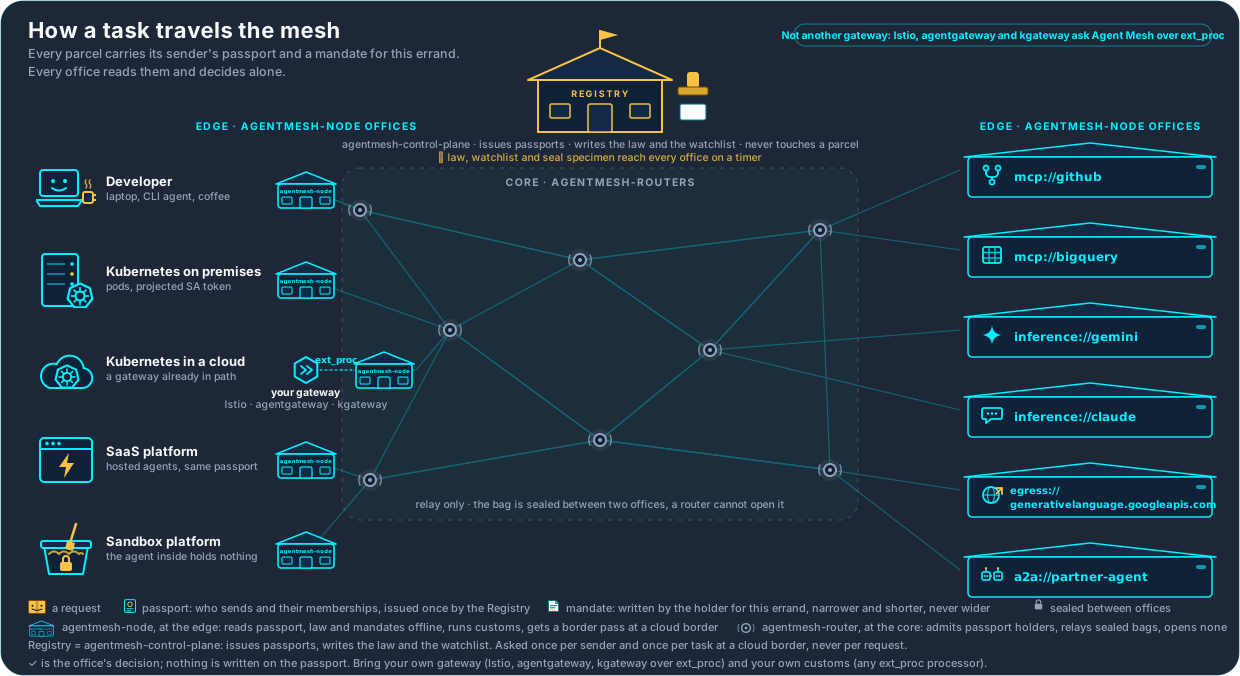
Agent Mesh moves tasks between environments that trust nothing on arrival, the way a courier network moves parcels between post offices:
| In the picture | In Agent Mesh |
|---|---|
| Parcel | One request: an MCP tool call, a chat completion, a BigQuery query, an A2A message. |
| Sender | The agent wherever it runs: a developer laptop, Kubernetes on premises or in a cloud, a SaaS platform, or a sandbox runtime. |
| Local post office | The agentmesh-node next to the agent, or the native SDK (@agentmesh-p2p/sdk, agentmesh-p2p) inside its process. It verifies the sender’s platform credential and obtains a task waybill from the control plane. |
| Your gateway | Istio, agentgateway, Envoy AI Gateway, or kgateway where a cluster already runs one. It stays in the data path and consults agentmesh-node over Envoy ext_proc, ext_authz, or RFC 8693 /oauth/token. |
| Waybill | The Agent Mesh Biscuit credential: who the subject is, through which actor node it travels, which roles it holds, and when it expires. |
| Stamp | An offline attenuation block (tar_block) appended at a task or sub-agent hop. Each stamp carries a serialized TaskAuthorizationRule and can only narrow authority. |
| Sealed bag | The mutually authenticated, encrypted libp2p stream between two nodes. Routers relay ciphertext across NATs, clusters, and clouds and cannot inspect it. |
| Registry | agentmesh-control-plane: verifies identities, issues Biscuits (POST /token/exchange), distributes Datalog policy, and acts as an OIDC issuer (POST /sts/token, /.well-known/openid-configuration, /jwks) for outbound cloud federation. |
| Destination office | The serving or egress agentmesh-node for mcp://, inference://, a2a://, or egress://: verifies the Biscuit and every tar_block stamp, runs content inspection, brokers the upstream credential, and delivers the request. |
| Customs | Content inspection at the egress node: built-in policy facts, Google Cloud Model Armor, and Envoy ext_proc callout processors. |
| Permit | The upstream destination credential: a federated cloud token exchanged via CloudTokenExchanger or a secret from the node’s vault, never held by the agent. |
| Receipts | Structured audit logs at the control plane, the origin and egress nodes, and the cloud provider, joined by principal and mesh_task. |
Why workload identity alone is not enough
In cloud and service-mesh architectures, permissions are granted ambiently to a workload identity (a Kubernetes Service Account, a cloud service account, or a SPIFFE SVID). Workload identity is necessary, but insufficient for AI agents:
- One workload, many tasks. A single agent service executes concurrent or
sequential tasks with different least-privilege boundaries (for example,
read-only access to
dataset_Ain one session and schema updates ondataset_Bin another). Workload identity proves which container is calling, not which task boundary applies to this request. - Prompt injection and confused deputy. If a session exercises the full standing privileges of its workload or user identity, a prompt injection during a narrow task can touch unrelated tools or datasets.
- Multi-hop sub-agent delegation. When an orchestrator delegates a
narrower sub-task to a sub-agent, it needs offline, progressive attenuation
(
Token_2 = Attenuate(Token_1, TaskRule)) without minting a new identity at the identity provider on every hop.
Agent Mesh separates the two layers:
| Layer | Question answered | Primitive |
|---|---|---|
| Subject & channel attestation | Which user or workload initiated this request, and through which node? | OIDC ID token, Kubernetes projected SA JWT, or SPIFFE JWT-SVID, exchanged into a Biscuit bound to the channel (client_peer_id, actor_node). |
| Task authorization (TAR) | What subset of standing permissions may this task or sub-agent hop exercise? | Appended tar_block blocks carrying api.TaskAuthorizationRule, intersected across hops and translated into downscoped cloud credentials at egress. |
Separation of responsibilities
OS and container confinement belongs to the sandbox platform (Kubernetes
agent-sandbox, NVIDIA OpenShell, Docker Sandbox docker sbx).
Local traffic interception belongs to the proxy (agentgateway, Istio,
Envoy, or agentmesh-node). Agent Mesh provides:
agentmesh-control-plane: the mesh authority, Datalog policy distributor, OAuth 2.1 Authorization Server, stateless token exchanger (POST /token/exchange), and OIDC issuer (POST /sts/token) for cloud federation.agentmesh-node: the Policy Decision Point (PDP), RFC 8693 Security Token Service (POST /oauth/token), Envoyext_authzandext_procserver, mesh router client, and egress credential broker.- Native SDKs (
@agentmesh-p2p/sdk,agentmesh-p2p): in-process mesh clients for TypeScript and Python that enroll, open authenticated streams, verify peers, and attenuate and seal task credentials in memory (session.attenuate(rule),session.seal()).
The two-token model: Biscuit inside, JWT at both borders
Inside the mesh, every credential is a Biscuit. External identity providers and cloud APIs speak standard JWTs and OAuth 2.1 / RFC 8693. Agent Mesh translates at both borders:
- Inbound border (
POST /token/exchangeon the control plane,POST /oauth/tokenon the node): The originagentmesh-nodepresents its own node Biscuit, a proof-of-possession signature overmesh:token-exchange:<peer_id>:<challenge_unix_ms>, and the caller’ssubject_token(an OIDC JWT, Kubernetes projected SA token, or SPIFFE JWT-SVID). The control plane verifies both, resolves the caller’s roles from the mesh policy, and mints a short-lived Delegated Session Biscuit with zero database writes:client_peer_id("<origin_peer_id>")andactor_node("<origin_peer_id>")bind the token to the origin node’s transport channel without granting the origin node’s ownnode:<peer_id>roles to the caller.user(...),email(...),group(...),idp_role(...), androle(...)carry the caller’s verified identity and resolved roles.
- In-mesh hops (offline
tar_blockattenuation): Before handing a token to a task runner or sub-agent, the holder appends aTaskAuthorizationRuleblock (tar_block("<base64url-proto>")) offline and optionally seals the token (Seal()) so downstream leaf processes cannot append further blocks. - Outbound border (
POST /sts/token+CloudTokenExchanger): When a request reaches an egressagentmesh-node(egress://<destination>), the node verifies the Biscuit signature, channel binding, standing Datalog policy, and every appendedTaskAuthorizationRule. On a cache miss for the Biscuit digest, it callsPOST /sts/tokenon the control plane, which re-verifies the token and mints a short-lived ES256 JWT (iss= control plane,sub= caller principal,act.sub= egress node peer ID,aud= destination audience,mesh_roles= caller roles,mesh_task= innermost task name). The egress node’sCloudTokenExchangerexchanges that JWT at the cloud provider’s STS endpoint.
Safe Biscuit attenuation (tar_block)
Agent Mesh never evaluates holder-authored Datalog rules or checks. In biscuit-go,
Datalog check if queries are not bounded by rule-iteration limits, and
allowing both Datalog checks and a serialized protobuf in an appended block
would let a crafted token make the mesh PEP and the cloud STS adapter disagree.
Instead, every appended block (block_idx >= 1, up to MaxAttenuationBlocks = 8)
must contain:
- 0 Datalog rules
- 0 Datalog checks
- Exactly 1 fact:
tar_block("<base64url-encoded api.TaskAuthorizationRule>")
All three verifiers (Go, TypeScript, and Python) enforce this structure before
building the Datalog authorizer, decode the TaskAuthorizationRule chain in a
single pass, and evaluate the rules directly in host code.
Positive allow-lists and intersection semantics
TaskAuthorizationRule uses strictly positive allow-lists:
- Within a single
TaskAuthorizationRule, a request is permitted if it matches at least oneTaskRule. An emptyruleslist denies everything. - Across appended blocks
1..k, semantics are strict intersection (logical AND): the request must be permitted by Block 0’s standing Datalog policy, arrive before every block’sexpire_time, and match at least oneTaskRulein every appendedTaskAuthorizationRuleblock.
Each TaskRule scopes:
allowed_services: service patterns (mcp://bigquery,inference://gemini.*,egress://bigquery.googleapis.com).operation.allowed_tools: MCP tool names enforced ontools/call.operation.allowed_methodsandoperation.allowed_paths: HTTP methods and exact or prefix (/prefix/*) paths.operation.allowed_permissionsandallowed_resources: cloud IAM permissions and resource prefixes intersected across all hops and consumed byCloudTokenExchangerat egress.
Gateway integration (agentgateway, Istio, Envoy)
Where a cluster already runs Envoy, Istio, or agentgateway, agentmesh-node acts
as their external Policy Decision Point and Token Service over three standard
interfaces:
- Envoy
ext_authz(on the local API listeners): evaluates standing policy andtar_blockchains on incomingCheckRequestcalls. The caller presents a Biscuit, or a platform JWT thatagentmesh-nodeexchanges at the control plane into a delegated Biscuit. OnOKit returnsX-Mesh-Biscuit,X-Mesh-Principal,X-Mesh-Roles,X-Mesh-Task-Idand, foregress://targets with a credential broker, the brokeredAuthorizationheader. - Envoy
ext_proc(envoy.service.ext_proc.v3.ExternalProcessor): the body-aware counterpart toext_authz. Because MCP tool names travel inside the JSON-RPC request body (params.name),ext_procinspects the buffered body to enforceoperation.allowed_toolsand injects the brokered credential only after the payload passes inspection. - RFC 8693 Token Exchange (
POST /oauth/token) & OAuth 2.1: acceptsgrant_type=urn:ietf:params:oauth:grant-type:token-exchangewith a JWT or Biscuitsubject_tokenand optionalTaskAuthorizationRule(inoptions,scope, orresource), returning a delegated or attenuated Task Biscuit. Unauthenticated MCP clients receive RFC 9728 Protected Resource Metadata (/.well-known/oauth-protected-resource) pointing to the control plane’s OAuth 2.1 Authorization Server (/oauth/authorize,/oauth/tokenwith PKCE).
Egress credential brokering, inspection, and TCP tunnels
An EgressDestination in the mesh policy configures how selected egress nodes
reach an external service:
- Credential brokers (
broker):static_secret: reads a secret file from--secrets-dir(Bearertoken oruser:passBasic auth).oidc_federation: mints a control-plane ES256 border JWT viaPOST /sts/tokenand exchanges it at an RFC 8693 STS endpoint such as Google Cloud Workload/Workforce Identity Federation (https://sts.googleapis.com/v1/token), optionally impersonating a service account (impersonate) with scopes narrowed by the TAR chain.aws_assume_role: exchanges the control-plane border JWT via AWSAssumeRoleWithWebIdentity, compiling the intersected TAR permissions and resources into an inline AWS session policy intersected with the configuredsession_policytemplate.platform_identity: uses the egress node’s ambient cloud identity (such as GKE Workload Identity metadata tokens) narrowed by scopes.
- Content inspection (
inspection.inspectors): Runs at the egress node before the broker injects the destination credential, so inspectors never see upstream secrets:- Model Armor (
model_armor): callssanitizeUserPromptand (inBUFFEREDmode)sanitizeModelResponsefor Gemini, OpenAI chat, MCPtools/call, and A2A payloads, blocking findings with403and replacing SDP de-identified text. - Envoy
ext_proc(ext_proc): streams headers, bodies, and trailers to an external gRPC processor withProcessingRequest.attributes["mesh"]populated (principal,roles,actor_node,task,service,destination), while refusing any processor mutation toAuthorization,Host,:authority, orX-Mesh-*. - Operator inspection chain (
preserve_host,forward_context): routes through an explicit outbound proxy while preserving the destinationHostheader and optionally forwardingX-Mesh-Principal,X-Mesh-Roles, andX-Mesh-Task.
- Model Armor (
- Named TCP tunnels (
mode: EGRESS_MODE_TCP): For non-HTTP TLS protocols (PostgreSQL, Cloud SQL, AlloyDB, Redis, SSH), the egress node exposes namedCONNECT host:porttunnels and the localagentmesh-node forward egress://<name>:<port> <local-addr>port forwarder. The egress node enforces the destination’sportsallow-list and inspects the TLSClientHellobefore splicing, refusing connections whose SNI does not match the authorized destination name or that hide the SNI with Encrypted Client Hello (ECH).
Control-plane STS sizing
agentmesh-node caches exchanged Delegated Biscuits by SHA-256(subject_jwt + tar)
and caches minted border JWTs and upstream cloud tokens by Biscuit digest,
keeping the control plane off the per-request hot path. You can measure raw
control-plane mint throughput and node cache hit rates on your hardware with:
agentmesh-bench sts --requests 200 --concurrency 8 --warmup 10
On a standard development workstation (8 concurrent workers, SQLite store):
| Phase | Throughput (req/s) | p50 Latency | p99 Latency | Cache Hit Rate |
|---|---|---|---|---|
Uncached POST /token/exchange | ~2,090 req/s | 3.6 ms | 7.8 ms | 0% (uncached baseline) |
Uncached POST /sts/token (Datalog + TAR + ES256) | ~130 req/s | 61.0 ms | 68.4 ms | 0% (uncached baseline) |
Cached ExchangeSubjectJWT (5m SPIFFE JWT-SVIDs) | ~18,500 req/s | 0.02 ms | 7.7 ms | >91% (99.7% steady-state) |
Cached ExchangeSubjectJWT (1h K8s SA tokens) | ~19,500 req/s | 0.02 ms | 6.7 ms | >92% (99.97% steady-state) |
Cached MintBorderJWT (15m task Biscuits) | ~1,980 req/s | 0.002 ms | 54.7 ms | >92% |